Kaiser Permanente and the Alliance of Health Care Unions

Alliance of Health Care Unions

Submitted by Laureen Lazarovici on Fri, 12/13/2019 - 15:23, last updated on Fri, 12/13/2019 - 15:23

KP and Alliance Reach Tentative Agreement on 4-year Contract

Story body part 1: 

Kaiser Permanente and the Alliance of Health Care Unions have reached tentative agreement on a 4-year contract, covering nearly 50,000 Kaiser Permanente health care employees in 22 local unions, and strengthening the Labor Management Partnership.

The agreement, reached November 13, 2021, includes new staffing language to continue to protect employees and patients, annual wage increases, and maintains benefits while providing career development and advancement opportunities for Alliance union-represented employees.

When ratified, the agreement will ensure Kaiser Permanente patients continue to receive safe, high-quality care and service; maintain Alliance union members’ industry-leading wages and benefits; and ensure Kaiser Permanente remains affordable for its members in the future. 

“The Alliance of Health Care Unions fought to preserve a Kaiser Permanente where patients can count on excellent patient care and service. This has guided our work for 24 years. This agreement will mean patients will continue to receive the best care, and Alliance members will have the best jobs,” said Hal Ruddick, executive director, Alliance of Health Care Unions. “This contract protects our patients, provides safe staffing, and guarantees fair wages and benefits for every Alliance member.”  

Kaiser Permanente and the Alliance unions have a longstanding history of successful bargaining to collaboratively address mutual interests of all parties.

“This landmark agreement positions Kaiser Permanente for a successful future focused on providing high-quality health care that is affordable and accessible for our more than 12 million members and the communities we serve. It also underscores our unwavering commitment to our employees by maintaining industry-leading wages and benefits,” said Christian Meisner, senior vice president and chief human resources officer at Kaiser Permanente. “These were challenging negotiations, but this tentative agreement demonstrates the strength of our Labor Management Partnership and the unique success it can achieve when we work together.”

Details of the tentative agreement include:  

  • Wage increases: Guaranteed across-the-board wage increases each year through 2025 in every region for all Alliance-represented employees.
  • Health benefits: No reductions or takeaways to already low-cost family medical and dental coverage with the same low co-pays for prescriptions and office visits. 
  • Retirement benefits: The Agreement maintains generous retirement income benefits and employer-subsidized retiree medical. 
  • Bonus opportunities: Introduction of the Alliance Bonus Plan, which provides annual payouts for achieving new mutually-agreed-upon objectives to address affordability.
  • New safe staffing and workload language: Will ensure every Kaiser Permanente patient receives extraordinary care every time and in every place.
  • Opportunities for career growth: Alliance-represented employees will continue to have excellent career development and advancement opportunities.

The Alliance and Kaiser Permanente have agreed to form a national Affordability and Competitiveness Task Force with specific targets to find innovative ways to address issues of affordability while continuing to work together to protect high-quality patient care. 

The tentative agreement was approved by members of the economic subcommittee of the Alliance of Health Care Unions and will now go to the union members for ratification. Voting on the tentative agreement will occur over the next several weeks. A senior Kaiser Permanente leadership group must also give its formal approval. If ratified, the agreement will have an effective date of October 1, 2021.

In light of this, the Alliance unions have canceled their strike notifications. 

Kaiser Permanente and the Alliance are part of the longest running, most successful, and innovative labor management partnership in the nation. 
 

Negotiations End Without Tentative National Agreement

Story body part 1: 

Negotiators for Kaiser Permanente and the Alliance of Health Care Unions wrapped up their last scheduled bargaining session on Friday without tentative national or local agreements in place.

The parties have not agreed on wages and benefits.

The contract expires September 30, 2021, and to date, no new negotiation sessions have been scheduled.

KP and Alliance leaders praised subcommittee members for developing several key proposals that were adopted by labor and management on issues including patient and worker safety, and resolution of workplace disputes.

For the latest joint bargaining updates, visit bargaining2021.org.

TOOLS

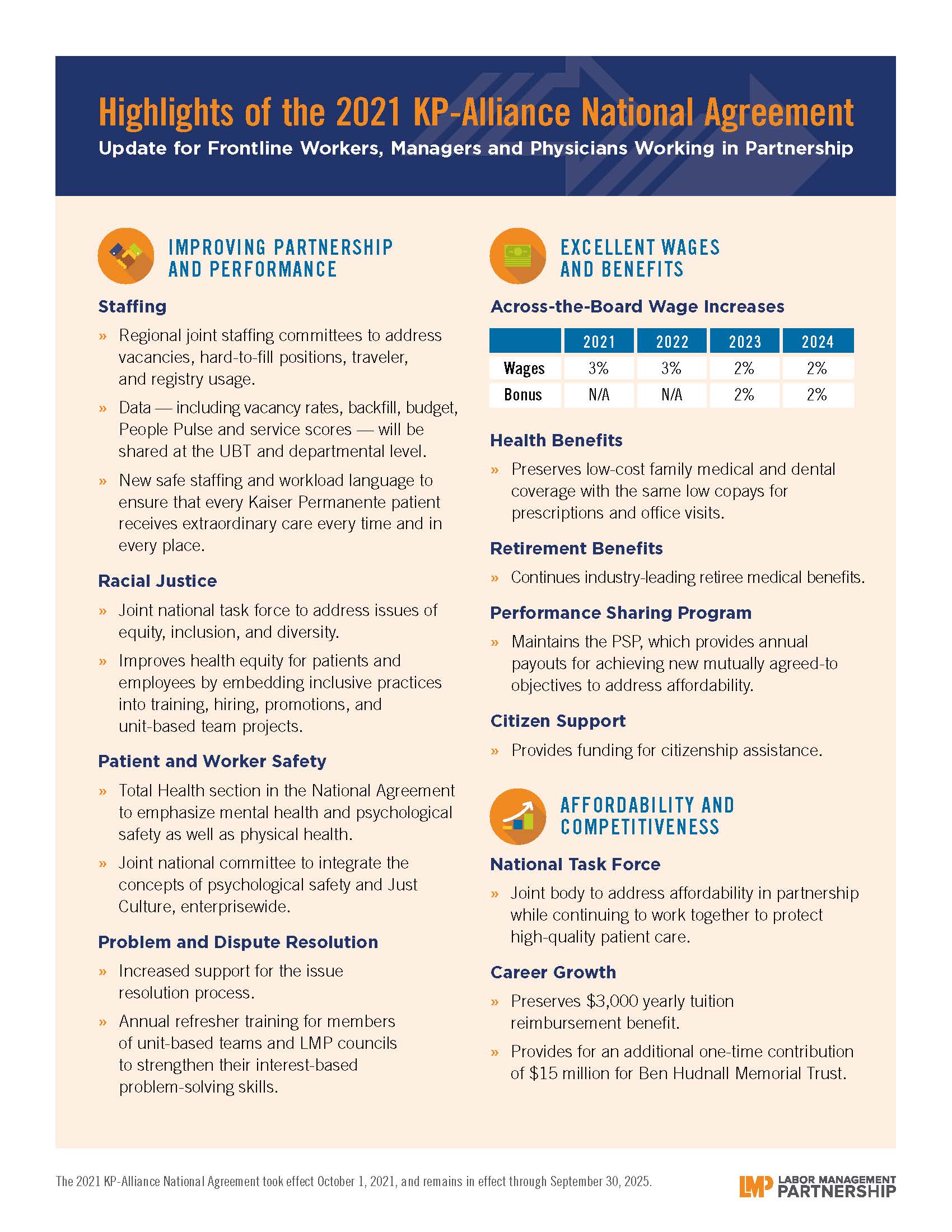
Highlights of 2021 KP-Alliance National Agreement

Format:
PDF

Size:
8.5" x 11"

Intended audience:
Employees who are members of unions in the Alliance of Health Care Unions and the managers they work with.

Best used:
To get a quick summary of the 2021 National Agreement between Kaiser Permanente and the Alliance.

Related tools:

National Agreement between Kaiser Permanente and Alliance Ratified

Deck: 
New 4-year contract advances best patient care and industry-leading wages and benefits

Story body part 1: 

Nearly 50,000 health care workers have overwhelmingly voted to ratify a 4-year contract with Kaiser Permanente that will help to ensure it remains a great place to work and receive care. The employees are represented by 22 local unions that are part of the Alliance of Health Care Unions and work across hundreds of job classifications in every geographic area where Kaiser Permanente has a presence.

The agreement includes annual wage increases and new staffing language for patient and worker safety, and maintains excellent benefits and innovative programs providing career development and advancement opportunities. This contract renews our shared commitment to the Labor Management Partnership and begins a new chapter where front-line caregivers and managers come together to address affordability and changing market conditions without sacrificing quality care or service.

“Our members have resoundingly endorsed a new national agreement that ensures Kaiser Permanente members can count on excellent care and service, and union members can count on the best jobs and benefits,” said Hal Ruddick, executive director, Alliance of Health Care Unions. “These negotiations were difficult, especially as our members are still battling the pandemic, but in the end the parties affirmed a joint commitment to working together, in partnership, to ensure the best future for union members, Kaiser Permanente, and our patients.”

“This contract reflects our deep appreciation for the extraordinary commitment and dedication of our employees throughout our response to the COVID-19 pandemic while also ensuring that we remain affordable for our members in the future,” said Christian Meisner, senior vice president and chief human resources officer at Kaiser Permanente. “We look forward to working together with our labor partners to implement the contract and further our mission of providing high-quality, affordable care.”

The ratified contract, which has an effective date retroactive to October 1, 2021, includes: 

  • Wage increases: Guaranteed across-the-board wage increases each year through 2025 in every region for all Alliance-represented employees
  • Health benefits: Continues family medical and dental coverage with the same low copays for prescriptions and office visits
  • Retirement benefits: Maintains generous retirement income benefits and employer-subsidized retiree medical benefits
  • Performance sharing: Continues the Labor Management Partnership Performance Sharing Program, which provides annual payouts for achieving new mutually agreed-to objectives
  • Safe staffing and workloads: New language to ensure every Kaiser Permanente patient receives extraordinary care, every time and in every place
  • Career growth opportunities: Continued excellent career development and advancement opportunities

The Alliance locals that ratified the contract and Kaiser Permanente also agreed to form a national Affordability and Competitiveness Task Force with specific targets to increase affordability while continuing to work together to provide the highest quality patient care.

Members of one bargaining unit, representing 1,500 United Nurses Associations of California/Union of Health Care Professionals pharmacists in Southern California, did not ratify the agreement. The contract will go into effect for all union members except that bargaining unit. UNAC/UHCP will return to the bargaining table with Kaiser Permanente.

Kaiser Permanente and the Alliance are part of an innovative relationship known as the Labor Management Partnership, a joint strategy to lead organizational change, create an environment of continuous learning and improvement, and involve the workforce in decision making.

Please see Highlights of the 2021 KP-Alliance National Agreement for more details about the contract.

CIC Approves Joint Recommendations, Remains Far Apart on Economics

Deck: 
Safety and dispute resolution gain traction

Story body part 1: 

Kaiser Permanente and the Alliance of Health Care Unions agreed on several significant issues this week as the full bargaining team resumed negotiations that they hope will lead to a new national contract.

With the current contract set to expire September 30, however, the Alliance and KP remain divided over key issues – including wages and benefits.

Labor and management representatives, meeting as the Common Issues Committee, approved subcommittee proposals to improve patient and worker safety, and the dispute resolution process.

Initial recommendations approved this week include:

  • Creation of a simple reference guide about the dispute resolution process.
  • Development of an annual refresher training for members of unit-based teams and LMP councils to strengthen their interest-based problem solving skills. Just-in-time training also would be offered to issue resolution participants.
  • Expansion of the Total Health section in the National Agreement to emphasize mental health and psychological safety as well as physical health.
  • Formation of a joint, national committee to integrate the concepts of psychological safety and Just Culture, enterprise-wide.  Efforts will encourage staff to air concerns without fear of punishment and emphasize a culture of shared accountability in which systems errors are scrutinized as closely as individual errors.

Other subcommittees are working on issues related to economics, racial justice, and staffing, backfill, and the use of travelers.

Because of concern about the spread of COVID-19, this bargaining session took place virtually. A small group of union and management representatives – including the LMP tri-chairs – met in person where they followed social distancing, masking, and other safety precautions.

What’s next

Labor and management leaders will review the remaining subcommittee recommendations and try to break a deadlock over wages and benefits.

Kaiser Permanente asserts it urgently needs to rein in costs. KP leaders say above-market compensation paid to union workers, along with wage and benefit increases that outpace the competition, are undermining efforts to make care more affordable and grow membership on the scale needed to stay competitive.

Alliance leaders counter that KP does not, in fact, pay significantly above competitors, can afford fair raises, and is advancing proposals that will worsen staffing shortages. Furthermore, union leaders say KP’s proposals fail to recognize the sacrifices made by frontline workers that enabled the organization to maintain strong profitability during the COVID-19 pandemic.

National bargaining is scheduled to resume September 8-10.

Videos

Bargaining Time

Loading the player...

(1:47)

Discover how interest-based bargaining can lead to creative, mutually beneficial solutions for labor and management that encourage deeper commitment to the final agreement.

Produced by Laurie Lezin-Schmidt

KP and Alliance Tackle Tough Economic Issues

Story body part 1: 

Six weeks into national bargaining between the Alliance of Health Care Unions and Kaiser Permanente, negotiators are expressing contrasting views about critical economic issues ─ including wages and benefits.

KP leaders, citing concerns about growing costs and competition, say action is needed to address wages and wage increases that consistently outpace those of market competitors contributing to a compensation disparity that grows wider every year. 

Alliance representatives, meanwhile, say industry-leading wages and benefits are one of the key tenets of the Labor Management Partnership that is detailed in our 2018 Alliance Labor Management Partnership Agreement and 2018 KP-Alliance National Agreement. Union leaders added that this year, more than ever, union members deserve strong wage increases for heroic work that enabled the organization’s robust performance during the pandemic.

While acknowledging tough talks ahead, the parties remain committed to our innovative Labor Management Partnership. Union and management leaders are confident that interest-based negotiations will yield an agreement that is best for frontline workers, patients, and Kaiser Permanente.

“We intend to adapt to the changing business environment together, honoring the partnership that has contributed so much to our success over the past two decades,” said Steve Shields, senior vice president of National Labor Relations and the Office of Labor Management Partnership.

Hal Ruddick, Alliance executive director, says partnership is based on the concept that empowered workers continuously innovate. This enables Kaiser Permanente to maintain its competitive edge, even amid new market challenges, while continuing to provide market-leading salary and benefits.

“We expect to continue beating the competition by innovating in partnership,” Ruddick said.

Differences over wages, benefits and other financial issues emerged during meetings of the Economic subcommittee in May and early June. 

KP leaders told subcommittee members that the organization is containing costs by restructuring management, consolidating office space and leveraging technology, among other methods – but it’s not enough. They say more needs to be done to restrain costs ─ and that includes controlling wages and benefits that make up nearly 50 percent of expenses. 

Alliance leaders say this view contradicts the hard numbers showing KP brought in more than $16 billion in net profit and over 700,000 new members since 2018.  They also say KP’s stated financial concerns are based on studies without union involvement.

The economic group is one of 5 subcommittees comprising representatives chosen by KP and union leaders. Other subcommittees are addressing dispute resolution, staffing, safety, and racial justice.

The subcommittees will continue meeting twice monthly through July, with the next Economic subcommittee session scheduled for June 14. The Common Issues Committee, the full bargaining team, is scheduled to meet virtually June 23 to hear updates on the subcommittees’ progress.

National Bargaining Unfolds as Subcommittees Get to Work

Deck: 
Participants outline the scope of their work and prioritize deliverables

Story body part 1: 

Bargaining between Kaiser Permanente and the Alliance of Health Care Unions began in earnest as subcommittee members discussed improvements in priority areas to be included in a new national agreement.

This year, 5 subcommittees are working on proposals related to problem and dispute resolution; staffing, backfill, and the use of travelers; patient and worker safety; racial justice; and economics.

Subcommittee members, meeting for the first time in early May, reviewed their charters and began to outline the scope of their work.

As we emerge from the hardest days of the pandemic, “there is a lot of healing we can do,” said Mena Yaft, service area administrator for Primary Care, Pediatrics, and Urgent Care in the Colorado region. 

Yaft was one of many members of the Patient and Worker Safety subcommittee who called national bargaining a prime opportunity to acknowledge the trauma managers and frontline workers experienced during the COVID-19 pandemic.  The committee agreed that improving “psychological safety” for workers and patients is their top priority for national bargaining.

Members of the Racial Justice subcommittee discussed ways to combat bias, advance racial equity in health outcomes and promote positive change within Kaiser Permanente and beyond.

“Sometimes we are downgraded because of how we look or how we sound. I want to do everything I can to change that,” said Sandra Flores, a business representative for IUOE Local 501 and the subcommittee’s Alliance co-lead.  “We have an incredible opportunity to make real change for those who work and receive care at Kaiser Permanente.”

Members of the Problem and Dispute Resolution subcommittee are charged with streamlining and speeding up the process for settling disagreements and supporting the use of interest-based problem solving. Prioritizing deliverables was an early success for the group.

“I’m proud of how engaged everyone was and how we reached consensus on working agreements,” said Eric Ruperto, program manager for the Office of Labor Management Partnership and the subcommittee’s management co-lead.

For Peter Sidhu, RN, UNAC/UHCP treasurer, the pandemic revealed “long-standing issues” related to staffing, backfill, and the use of travelers – the topic of his subcommittee.

“We realized there are a great deal of flaws in how we approach staffing, how we fill vacant positions, and how we utilize traveler RNs,” said Sidhu, one of 2 Alliance co-leads for the subcommittee.

The subcommittees are following an interest-based process to develop recommended updates to the national agreement.  Unlike traditional bargaining where each side takes an adversarial position, interest-based bargaining calls for the parties to identify common issues of concern and work collaboratively to achieve mutually beneficial solutions.

The subcommittees will continue meeting twice monthly through July.  The Common Issues Committee, the full bargaining team, is scheduled to meet virtually June 23 to hear updates on the subcommittees’ progress.

KP and Alliance Kick Off National Bargaining

Deck: 
Virtual session opens with a call for Partnership

Story body part 1: 

Acknowledging tough talks ahead, KP and Alliance leaders held up their successful partnership during the pandemic as a model to meet future challenges during this week’s virtual kickoff session for national bargaining.

The 2-day session began April 20 with presentations by management and union leaders about their priorities for national bargaining.

AFL-CIO Secretary-Treasurer Liz Shuler was one of several speakers who presented the union perspective. “Kaiser Permanente’s success has always gone hand in hand with industry-leading wages and benefits and its talented workforce is the reason it is successful,” said Shuler, noting that the Alliance enjoys the full support of 56 international unions. She predicted that negotiations would set a positive example for the health care industry and provide a path of economic opportunity for represented workers around the country.

Alliance Executive Director Hal Ruddick, joined by union leaders, described the losses, trauma, and bravery of union members during the pandemic.  While he expressed optimism about the negotiations, Ruddick vowed that the Alliance would press for a national agreement that preserves the best jobs and best care.

The management perspective was delivered jointly by Chris Grant, executive vice president and chief operating officer for The Permanente Federation; and Janet Liang, executive vice president, group president and chief operating officer in charge of care delivery for Kaiser Foundation Health Plan and Hospitals.

Liang and Grant, noting greater competition and disruption caused by COVID-19, urged management and labor to work together to increase innovation, improve flexibility, and support sustainable wages and benefits. Collectively, those actions will enable KP to continue providing high-quality care and service to our members, patients, and communities.

On the second day, negotiators received training in interest-based bargaining, which calls for both parties to identify common issues of concern and work collaboratively to achieve mutually beneficial solutions.

This round of bargaining marks the second time that KP and the Alliance of Health Care Unions have negotiated a national contract since the Alliance, which comprises 22 local unions, formed in 2018. The current national agreement expires September 30, 2021.

Bargaining sessions are scheduled to run through September and will involve more than 100 management and labor representatives from across the organization.

The next session is scheduled for June 23, when members of the Common Issues Committee (CIC) – the full negotiating team – will meet virtually to hear progress from subcommittees tasked with addressing this year’s bargaining topics. For regular updates, visit bargaining2021.org.

Social Media Best Practices

Story body part 1: 

As we negotiate a new national agreement between Kaiser Permanente and the Alliance of Health Care Unions, we ask that you respect the bargaining process by following these social media guidelines. Doing so will help ensure the spirit and integrity of our interest-based negotiations.

  • DO adhere to the spirit of partnership in your social media posts.
  • DON’T reveal confidential information – including information shared during caucus meetings, private communications, or any other sensitive details.
  • DO express your own opinion. Make clear that you’re expressing your personal views. The freedom to speak up and share ideas without fear of retaliation is an important part of the interest-based bargaining process. When engaging on social media, we ask you to refrain from attacking others, quoting individuals by name, or commenting on specific discussions. We all must model the spirit of partnership by working together to achieve creative, mutually beneficial solutions that help us maintain respectful and constructive relationships.
  • DO share links from our new bargaining website,  bargaining2021.org.
  • DO follow and share social posts from LMP, the Alliance and affiliate unions .

Sample Social Media Posts

Need inspiration? Here are examples of social media posts that you can use:

Cyber safety

Cyber hacks and threats are common. Protect yourself online by following these common-sense cyber safety tips:

  • Limit the personal and professional information you share.
  • Choose strong passwords.
  • Practice safe browsing.
  • Make sure your Internet connection is secure.
  • Do not download or click on suspicious content.

Contact Information

Have questions or need more information about our social media guidelines? Please email your queries to LMPComms [at] lmpartnership.org.


Pages

Subscribe to RSS - Alliance of Health Care Unions