Kaiser Permanente and the Alliance of Health Care Unions

LMP News

Bargaining Subcommittees

Story body part 1: 

Four subcommittees, made up of representatives chosen by KP and union leaders, will examine issues of importance to labor and management.  This year, those topics include problem and dispute resolution; staffing, backfill, and the use of travelers; patient and worker safety; and racial justice.

Each subcommittee is led by a management and union representative. Instead of taking hardline positions, subcommittee members stake out common interests. During the course of bargaining, assisted by outside facilitators, they identify interests and develop options.

Subcommittees will report on their progress at key “check-in” meetings with the Common Issues Committee (CIC) in June and August.

The four subcommittees and their co-leads are:

Problem and Dispute Resolution

  • Management co-lead: Eric Ruperto
  • Alliance co-lead: Julie Kwiek 

Staffing, Backfill and Travelers

  • Management co-leads: Aileen Oh and Jerry Spicer
  • Alliance co-leads: Jodi Barschow and Peter Sidhu

Patient & Worker Safety

  • Management co-lead: Maria Dee
  • Alliance co-lead: Charmaine Morales 

Racial Justice

  • Management co-lead: Laura Long
  • Alliance co-lead: Sandra Flores

National Bargaining Between KP and the Alliance Begins

Deck: 
Virtual kickoff sets the stage for arriving at a second national agreement

Story body part 1: 

Kaiser Permanente and the Alliance of Health Care Unions kicked off national bargaining on April 20 under a streamlined virtual format driven in part by the COVID-19 pandemic.

Bargaining sessions are scheduled to run through September and will involve more than 100 management and labor representatives from across the organization. This marks the second time that KP and the Alliance have negotiated a national contract since the Alliance, which comprises 22 local unions, formed in 2018. The current national agreement expires September 30, 2021.

A different bargaining experience

Like so much else during the pandemic, this bargaining year differs significantly from the past. Most sessions will be held virtually, with in-person meetings scheduled for late August and September.

In addition, the number of bargaining sessions has been reduced from 30 sessions in 2018 to 14 for 2021. During those sessions, subject matter experts chosen by management and labor will form subcommittees to address specific topic areas. This year, those topics include problem and dispute resolution; staffing, backfill, and the use of travelers; patient and worker safety; and racial justice.

Hal Ruddick, executive director of the Alliance, said the Labor Management Partnership is more important than ever as both parties seek new ways to work together in a difficult health care environment.

“The pandemic has been difficult for all of us, especially our frontline health care workers,” said Ruddick. “We’re looking forward to upholding our partnership commitment to the best jobs and the best performance to prepare for future challenges.”

Interest-based bargaining

The Alliance represents almost 50,000 workers enterprisewide, nearly half of whom are represented by United Nurses Associations of California/Union of Health Care Professionals. Under the 2018 Labor Management Partnership Agreement, KP and the Alliance agreed to work collaboratively to improve the quality of care for members and communities and help KP lead the market in health care — while preserving industry-leading benefits and working conditions for employees.

Steve Shields, senior vice president of National Labor Relations and Office of Labor Management Partnership, said he looks forward to negotiating a new agreement with the Alliance.

“I’m excited to be involved in national bargaining this year and to use an interest-based process that has served Kaiser Permanente and its labor partners so well over the years,” said Shields.

Unlike traditional bargaining where each side takes an adversarial position, interest-based bargaining calls for the parties to identify common issues of concern and work collaboratively to achieve mutually beneficial solutions. The process helps labor and management maintain a respectful and constructive relationship while creating a deeper commitment to the final agreement.

TOOLS

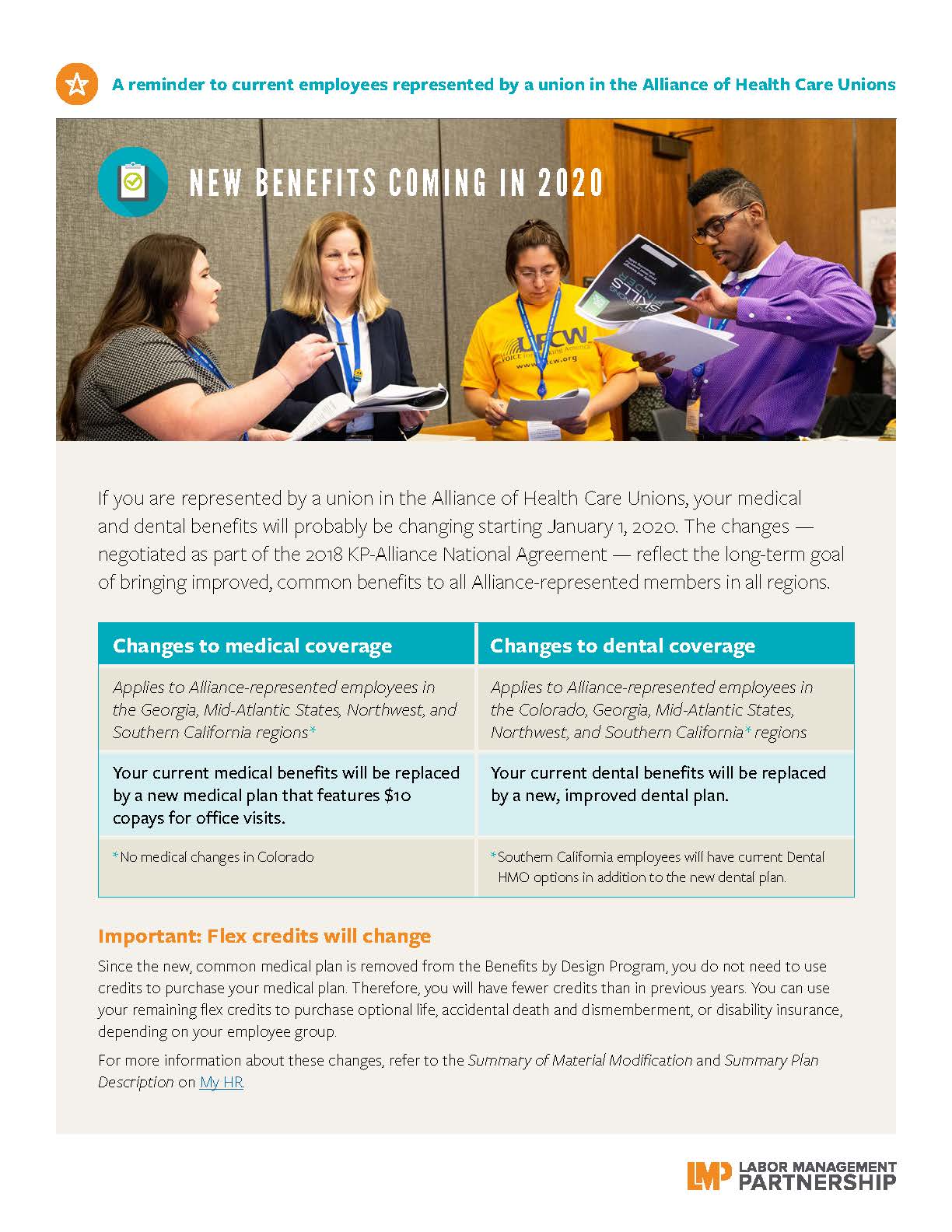
New Benefits for Members of Alliance Unions

Format:
PDF

Size:
One page, 8.5" x 11"

Intended audience:
Members of unions in the Alliance of Health Care Unions and their managers 

Best used:
Hand out and post this flier that summarizes the medical and dental benefit changes for 2020. Additional details are available on the Alliance website

Related tools:

eStore

back to eStore
Hank cover

Hank Q4-2017

Celebrate the 20th anniversary of the Labor Management Partnership. We are taking the high road, and there's no turning back!

Plus: Tips and tools for both rookie and veteran leaders of unit-based teams, as well as puzzles and games to mark our milestone. 

You can also visit the Q4-2017 Hank web page in the Gallery section to read the issue online or download a PDF of it. 


Minimum order: 25

How to Use LMPartnership.org

Story body part 1: 

Need a poster, video or article to share with your team? Looking for a copy of your union’s contract? This training will show you how to easily find and share information on LMPartnership.org from your desktop and your smartphone.


Training description

LMPartnership.org contains many tools employees, managers and teams need at work. This interactive training will show you and your colleagues how to navigate the site. You'll learn how to quickly locate, save and share successful practices, Path to Performance tips, icebreakers for your UBT meeting, and more. 


Path to Performance

Levels 1—5

Duration

Usually 30 minutes to 60 minutes. Can be customized to suit your team’s needs.


Who should attend

This in-person training is for unit-based teams, LMP councils, unit/departments, and other groups.


Labor Management Partnership Celebrates 20th Year

Deck: 
As membership hits 150,000, California's governor congratulates LMP on two decades of growth and union success

Story body part 1: 

Twenty years ago this fall, Kaiser Permanente and the Coalition of Kaiser Permanente Unions formed the innovative Labor Management Partnership—a new way of working that now includes more than 150,000 managers, physicians and union-represented workers across Kaiser Permanente.

To commemorate this event, California Governor Jerry Brown has issued a proclamation congratulating Kaiser Permanente and the Coalition of Kaiser Permanente Unions for 20 years of successful partnership and collaboration.

“This model has resulted in improved patient outcomes, workplace innovations, process efficiencies, and measurable service and quality enhancements while creating a safer, healthier work environment with opportunities for health care workers to improve their skills and advance their careers,” said Governor Brown, “I commend all of the organizers and participants in this process for making the Golden State a better place to live and raise our families.”

The Labor Management Partnership is proof that labor unions aren’t just about making things better for workers, but improving outcomes for everyone. In just the first six months of 2017, partnership teams launched nearly 10,000 self-directed projects to improve Kaiser Permanente’s quality, service, and affordability. Departments with strong employee engagement report:

  • 60 percent fewer patient falls with injuries
  • 38 percent fewer workplace injuries
  • 21 percent fewer lost work days
  • 13 percent improvement in patients’ overall hospital satisfaction

California Governor Honors Our Partnership

Jerry Brown commends our Labor Management Partnership for making the state a better place to live and raise families.

(1:10) | September 29, 2017

In 2016, the partnership also helped Kaiser Permanente to keep costs down, with teams working together to save more than $48 million, on top of $35 million saved in 2015. 

More than 74 percent of Kaiser Permanente’s workforce is unionized. By contrast, 6.4 percent of private-sector workers nationwide belong to a union, according to the Bureau of Labor Statistics. Union representation is supported by a growing number of Americans, an August 2017 Gallup poll suggests. Sixty-one percent of adults surveyed say they approve of labor unions, the highest percentage since the 65 percent approval recorded in 2003.

Working together, Kaiser Permanente and the Coalition of Kaiser Permanente Unions will continue to improve health care for members and the community overall. Together we thank our workers, managers and physicians for their dedication, and appreciate Governor Brown’s recognition of their accomplishments.


Past, Present and Future

Story body part 1: 

As we celebrate the 20th anniversary of the Labor Management Partnership, Hank would like to call out the tens of thousands of individuals who have made partnership a success: the frontline workers, managers and physicians who have believed in our ideals and taken the time to build the positive working relationships that are the backbone of this groundbreaking endeavor.

Visit Humans of Partnership to read their stories—and look through their eyes into our past, our present and our future. 


The View From the High Road

Deck: 
Our 20-year partnership journey

Story body part 1: 

Where were you 20 years ago? The three of us were each on a different path—paths that crossed in unexpected ways, and changed the way we do our jobs.

Our Labor Management Partnership often is described as a journey, for good reason. It is ever changing. It can be difficult. And you never know where it’s going to take you next. But it also has a few rules of the road that help us find our way:

Understand and respect one another’s needs and interests. Listen openly and assume the best intentions of your counterparts. Ask questions, especially, “Why?” Create an environment where people feel safe speaking up.

Over the years, that approach has gotten positive outcomes for Kaiser Permanente, our unions, our workforce and, most important of all, our members and patients.

That doesn’t mean our partnership is perfect; it isn’t. Or that we always agree; we don’t. But we’ve tried the traditional ways of working, and the trip is much better on the high road that Kaiser Permanente and the Coalition of Kaiser Permanente Unions have chosen.

Thank you for your hard work and dedication. We invite you to join colleagues in your unit, department or region this fall to celebrate your accomplishments, reflect on our challenges, and commit to creating an even better future.

Partnership Beats the Odds

Deck: 
Kaiser Permanente and Coalition of KP Unions celebrate 20 years of partnership

Story body part 1: 

Forty percent of U.S. marriages end in divorce after an average of eight years. Most business partnerships fail to meet expectations. And most campaigns end when they achieve their goals or the world moves on.

But the Labor Management Partnership between Kaiser Permanente and the Coalition of Kaiser Permanente Unions has beaten the odds: October 2017 marks the 20th anniversary of the partnership’s founding, making it by far the largest, longest-running and most sweeping such partnership in the country.

We’ve accomplished a lot together. And in a world of change, sustaining a healthy long-term relationship is an achievement in itself. A key to our success has been the willingess to honestly reflect on our successes, failures, and opportunities to improve. 

By working in partnership, says Kaiser Permanente Chairman and CEO Bernard Tyson, “We have tapped into the potential of smart people all over the organization coming here every single day trying to figure out, ‘How do I improve quality, how do I improve service, how do I improve affordability?’ That’s an incredible competitive advantage for the organization.”

Marking a milestone

This fall Kaiser Permanente and the union coalition will be celebrating those achievements with special events and employee outreach. It won’t be all cake and balloons, however. LMP regional councils, unit-based team sponsors and co-leads, and others will host reflection sessions where workers, managers and physicians can share their experiences, pain points and suggestions for the future of partnership. Participants will consider three questions:

  • What is different since we created partnership? (Or, what do you see as the top accomplishments of partnership?)
  • What are the greatest challenges it faces today?
  • How might we address those challenges, to strengthen partnership now and in the future?

Getting results

Partnership is not easy, and the parties don’t always agree on things. So what’s kept it going?

“It’s nice if we can all get along,” says Tyson. “But most important, we’re here to get results.” Here are some of the results achieved in partnership:

  • Performance improvement: More than 50,000 team-led improvement projects since 2007, with measurable gains in quality, service, the work environment—and cost savings exceeding $48 million in 2016.
  • Best place to work: Industry-leading wages and benefits, a voice in decision making, and an Employment and Income Security Agreement providing retraining and redeployment for displaced workers.
  • Joint marketing: Strategic engagement brought strong gains in KP membership, union coalition membership, and more than $108 million in revenue for Kaiser Permanente in 2016.
  • Job training and career advancement: More than 300,000 professional, academic and skill-enhancement courses taken by 104,000 coalition-represented employees since 2007.
  • Systems collaboration: Joint implemention of multiple complex programs and systems, including KP HealthConnect, Claims Connect, ICD-10 and call center reorganization.

Lessons for success

All of the above have garnered attention from business, union and academic leaders over the years.

“The Labor Management Partnership is a shining example of how you bring labor and management together to produce results,” said Liz Shuler, secretary-treasurer of the AFL-CIO. “What I love about this model is the notion that, no matter where you work in the system, you have a place at the table and your voice is heard.”

Working in partnership also holds lessons that apply outside of work—including lessons that might have saved some of those failed marriages.

“If you are going to be a good partner and have a successful relationship, with a partner, kids, friends,” says a facilitator from 2015 national bargaining, “you have to have your partner’s needs in mind as well as your own.”

To learn more about LMP anniversary activities, visit the 20th Anniversary How-to Guide.
Pages

Subscribe to RSS - LMP News